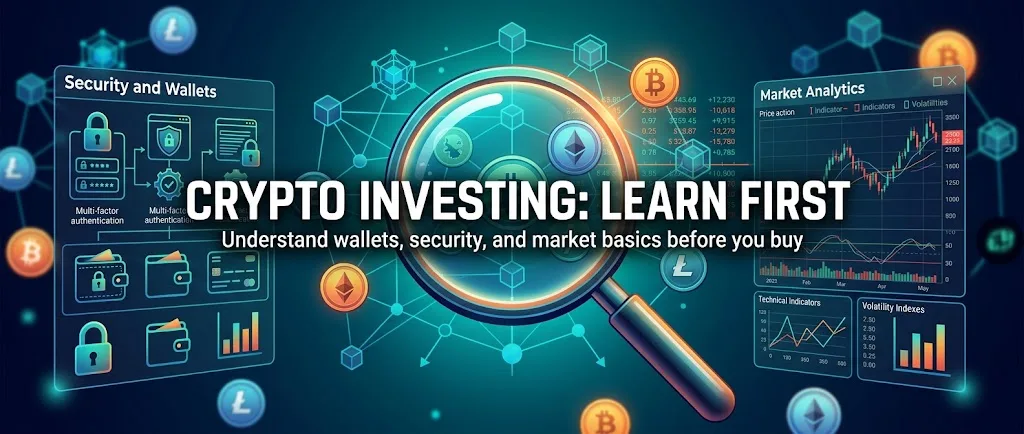
Crypto Investing 101: A Beginner's Guide Before You Buy
A crypto beginners guide: what crypto is, how to judge a coin, the five risks unique to crypto, and a checklist to run before your first purchase.
Most painful crypto stories start the same way: someone bought first and learned later. A coin takes seconds to buy. Understanding what you bought takes a little longer, and that's the part that protects your money.
This crypto beginners guide is your crypto investing 101: what crypto actually is, how to judge a coin, the risks that are unique to this market, and a checklist to run before your first purchase. Ten minutes now can save you a lot of regret later.
Cryptocurrency investing 101: what crypto is, in plain English
Crypto is a digital asset recorded on a blockchain: a shared ledger of transactions kept by thousands of computers instead of one bank. Because no single company controls it, no single company can reverse a payment or freeze your coins.
That freedom cuts both ways. Nobody can block you, but nobody can rescue you either. Lose access to your wallet or send coins to the wrong address, and they're usually gone for good.
How to judge a coin in three questions
Every coin claims to do something: move money cheaply, power apps, store value. Many claim very little. Before you buy, answer:
- What problem does it solve, in one sentence?
- Is that a real problem for people who don't already own the coin?
- What has to happen for it to be useful, and how long might that take?
If you can't answer the first one, you don't understand the coin well enough to invest in it yet.
Who's behind it?
A coin doesn't run itself. Someone writes the code, funds development and decides what changes. Check:
- Is there a clear website and documentation?
- Is the team or foundation publicly named?
- Is there a track record of regular updates?
Red flags: an anonymous team, promised returns, and hype instead of documentation.
A crypto screener can help you narrow down which coins to research, but this part you have to do yourself.
The 5 risks unique to crypto
| Risk | What it looks like |
|---|---|
| Big price swings | Falls of 50% or more within weeks happen. Expect them. |
| Scams | Fake exchanges, impersonators on social media, "guaranteed returns" |
| Lost access | A lost recovery phrase can mean losing your coins forever |
| Changing rules | Crypto laws and taxes differ by country and can change |
| Thin information | Many coins have little reliable public data |
None of these mean you should stay away. They mean you should know them before you put money in.
Plan first, pick second
Beginners often spend hours choosing a coin and minutes deciding how much to invest. Flip that. Decide:
- How much you can afford to lose without touching rent, savings or daily life.
- How big your position should be. A small share is far easier to hold through a crash.
- How you'll add to it: one purchase, or a regular schedule like pound (dollar) cost averaging.
- When you'll review it, and what would make you pause.
A plan won't prevent losses. It stops you from making a bigger mistake in a panic.
Your pre-purchase checklist
You're ready when you can say yes to all five:
- ✅ I can explain what this coin does in one sentence.
- ✅ I've checked who's behind it myself.
- ✅ I accept that the price can fall sharply.
- ✅ I've written down how much I'll invest and why.
- ✅ This is money I can leave alone for at least a year.
Any "no"? Keep learning. There's no deadline, and the market will still be here next month.
Your crypto 101 course: the Stratalla Academy
Want to go deeper? The Stratalla Academy is a step-by-step crypto 101 course for complete beginners, with short lessons and quizzes. It covers:
- How crypto works, and why a "cheap" coin isn't really cheaper
- Wallets, seed phrases and spotting scams
- Choosing an exchange and making your first purchase safely
- Why prices move in waves, and how to read them
- Building a portfolio, managing risk and DCA
- Doing your own research, with a one-page buy checklist
No trading jargon needed, and the beginner lessons are free. Stratalla never tells you what to buy or when to sell. It teaches you how to ask better questions.
Related articles
-
 Crypto basics
How to Find the Best Crypto Course for Beginners: A Checklist
Crypto courses range from honest education to sales funnels. An 8-point checklist to find the best crypto course for beginners, and the red flags to walk away from.
-
 Crypto basics
How to Learn Crypto Before You Invest (and Why It Pays Off)
Most crypto losses start with buying what you don't understand. Why it pays to learn crypto first, the four classic beginner mistakes, and how to start.
-
 Crypto basics
Best Crypto Screener for Beginners: How to Choose and Use One
How to find the best crypto screener: what a screener does, the four numbers that matter, how to use one in six steps, and what beginners should look for.