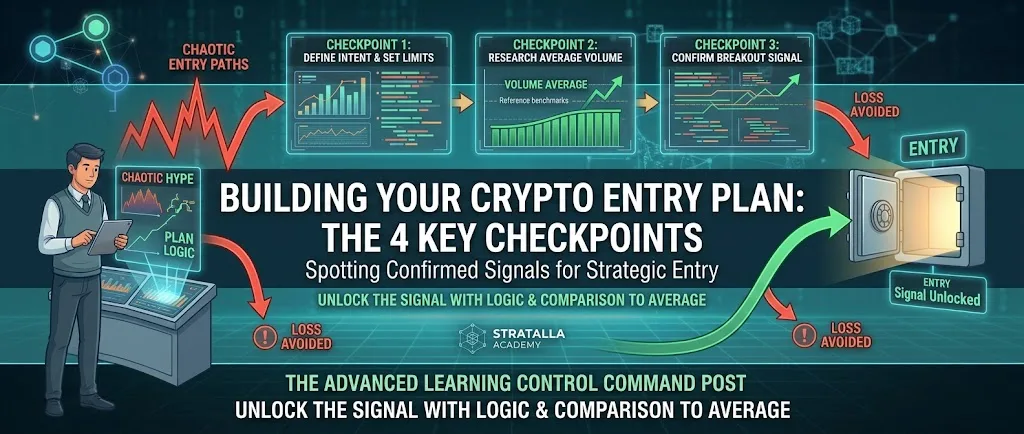
Crypto Entry Plan: What It Is and How People Build One
What a crypto entry plan is, why people write one down, the common ways to structure it, and what a plan can and can't do.
Decisions about crypto purchases are often made in a rush. A price jumps, a headline appears, and the choice suddenly feels urgent. A crypto entry plan is a written set of conditions, decided in advance and in a calm moment, that describes when and how a purchase would be made. This guide explains what goes into one, why people write one, and where its limits are.
What is a crypto entry plan?
An entry plan is a short written record of a purchase decision, made before the moment arrives. It names the coin, the total amount, how many parts that amount is split into, the price conditions or dates for each part, and what would make the plan invalid. The thinking happens first; the moment only gets checked against it.
Most entry plans cover the same five points:
- The coin. Which single coin the plan is about, and why it was chosen in the first place.
- The total amount. The most the whole plan would ever commit, decided before any part of it happens.
- The number of parts. Whether the total goes in at once or is split into several smaller purchases.
- The conditions. A price condition ("if the price reaches this level") or a date ("on the first day of the month") for each part.
- What would invalidate it. The facts that would make the plan worth reconsidering, such as a change in the project, a change in personal circumstances, or the original reason no longer holding.
The last point is the one most often skipped. A plan without a "this no longer makes sense" condition can turn into a habit of following old instructions after the reasons behind them have changed.
Why do people write an entry plan down?
People write entry plans down to separate the decision from the emotion of the moment. Fast price moves can trigger FOMO, the fear of missing out, which pulls people toward chasing a rising price or acting on a headline. A plan written earlier gives a calmer reference point to compare against.
Chasing means making a purchase after a sharp rise mainly because the price is moving, not because anything about the original reasoning has changed. A written plan makes that difference easier to see. If a purchase isn't in the plan, the question becomes "what has changed?" rather than "what if I miss it?"
Writing also exposes vague thinking. "I'll get in when it's cheaper" sounds like a plan, but cheaper than what, and by how much? Putting a condition on paper forces a specific answer, or shows that there isn't one yet.
Entry plans usually sit inside a wider plan that covers goals, time frames and risk. The guide on investing in crypto for beginners walks through that bigger picture.
How can an entry plan be structured?
Most entry plans take one of three shapes. A single entry puts the whole amount in under one condition. Staged entries split the amount across several price conditions. Date-based entries tie each part to a date on the calendar. Each shape reflects a different crypto entry strategy, and each comes with its own trade-off.
| Structure | What sets each purchase | Main trade-off |
|---|---|---|
| Single entry | One price condition or one date | Simple, but rests on one moment |
| Staged entries | Several price conditions | Spreads the decision, but some levels may never be reached |
| Date-based entries | A set date for each part | Ignores price completely |
| Dollar cost averaging | A repeating schedule | Routine only, no price conditions |
Here is a staged example with a made-up coin and made-up prices. Someone plans a total amount split into three equal parts: one part at $10, one at $8 and one at $6. If the price touches $10 and $8 but turns back up before reaching $6, two parts happen and the third doesn't. The plan worked exactly as written, even though only two-thirds of the amount was used.
Date-based entries can look like dollar cost averaging, but they differ. A date-based entry plan is usually a fixed set of purchases with an end point, and it can be mixed with price conditions. Dollar cost averaging is purely schedule-based: the same amount on a repeating schedule, with no price conditions at all. The article on dollar cost averaging crypto covers it in detail.
Some people combine shapes, with a few parts tied to dates and a few to price conditions. Which shape feels right often comes down to temperament.
What does an entry plan not do?
An entry plan doesn't make a price happen, doesn't remove risk, and doesn't promise that any part of it will be used. Price conditions can be skipped entirely if the market never reaches them, and a purchase made exactly as planned can still fall in value afterwards. A plan organizes a decision; it doesn't control the outcome.
This cuts both ways. A level that is never reached may leave the plan unused while the price moves away. A level that is reached may be followed by further falls. Neither outcome means the plan failed. A plan describes intentions, not results.
How much to put into a plan is a question about personal situation. Income, savings, debts, time horizon and how someone would feel if the amount fell sharply all shape it, and no article can answer it for someone else. That's why this guide gives no amounts or percentages.
An entry plan also covers only one side of a position. Deciding when and how to reduce or close a holding is a separate exit plan, and it deserves its own thinking.
How does Stratalla record entry plans?
In the portfolio tool, an entry plan stores a coin, either a target price or a target date, a quantity and an optional fee. When the coin's price reaches the target price, or the target date arrives, Stratalla records the planned purchase in the portfolio as a transaction. It is a record only.
Stratalla doesn't place orders or trade on any exchange, and it doesn't connect to exchanges or wallets. Any real purchase is made separately, outside Stratalla. If a real purchase didn't happen, or happened at a different price, the record and reality won't match, which is worth keeping in mind.
Like any other transaction, a recorded entry counts toward the portfolio's figures: each holding's average buy price, total cost including fees, and allocation, meaning its share of the portfolio.
Stratalla doesn't tell anyone what to buy or sell, and it doesn't predict prices. The coin, the levels, the dates and the amounts in an entry plan are always the user's own choices.
Quick answers
Is an entry plan the same as dollar cost averaging?
No. Dollar cost averaging follows a repeating schedule with no price conditions. An entry plan can use price conditions, dates or both, and it usually has a set total and an end point.
Does an entry plan reduce risk?
It doesn't remove risk. It can reduce decisions made in a rush, but the coin can still fall in value after any part of the plan happens.
What happens if a price level is never reached?
That part of the plan simply doesn't happen. Many plans include a point at which unused parts get reconsidered, rather than left waiting indefinitely.
Can an entry plan change?
Plans often change. The difference people look at is whether the change comes from a reason the plan already named, such as a change in the project or in personal circumstances, or from a sudden price move.
This article is for education only. It isn't financial advice, and nothing here recommends buying or selling any asset. Crypto prices can fall sharply, and you can lose money. Consider your own situation, and speak to a qualified adviser if you need personal guidance.