Crypto Narratives: How They Start, Spread and End
What crypto narratives are, how past ones from Bitcoin to AI started and faded, what Stratalla's data on 13 narratives shows, and a checklist for telling a real one from hype.
Crypto narratives are shared stories about why a group of coins should matter: Bitcoin as digital gold, Ethereum as a programmable computer, AI on the blockchain. A narrative gives many people the same reason to look at the same coins at the same time, and for a while that attention can move their prices together. This guide explains what a narrative is, walks through the main ones in crypto's history, shares what Stratalla found when it measured 13 of them, and ends with a checklist for telling a real narrative from hype.
What are crypto narratives?
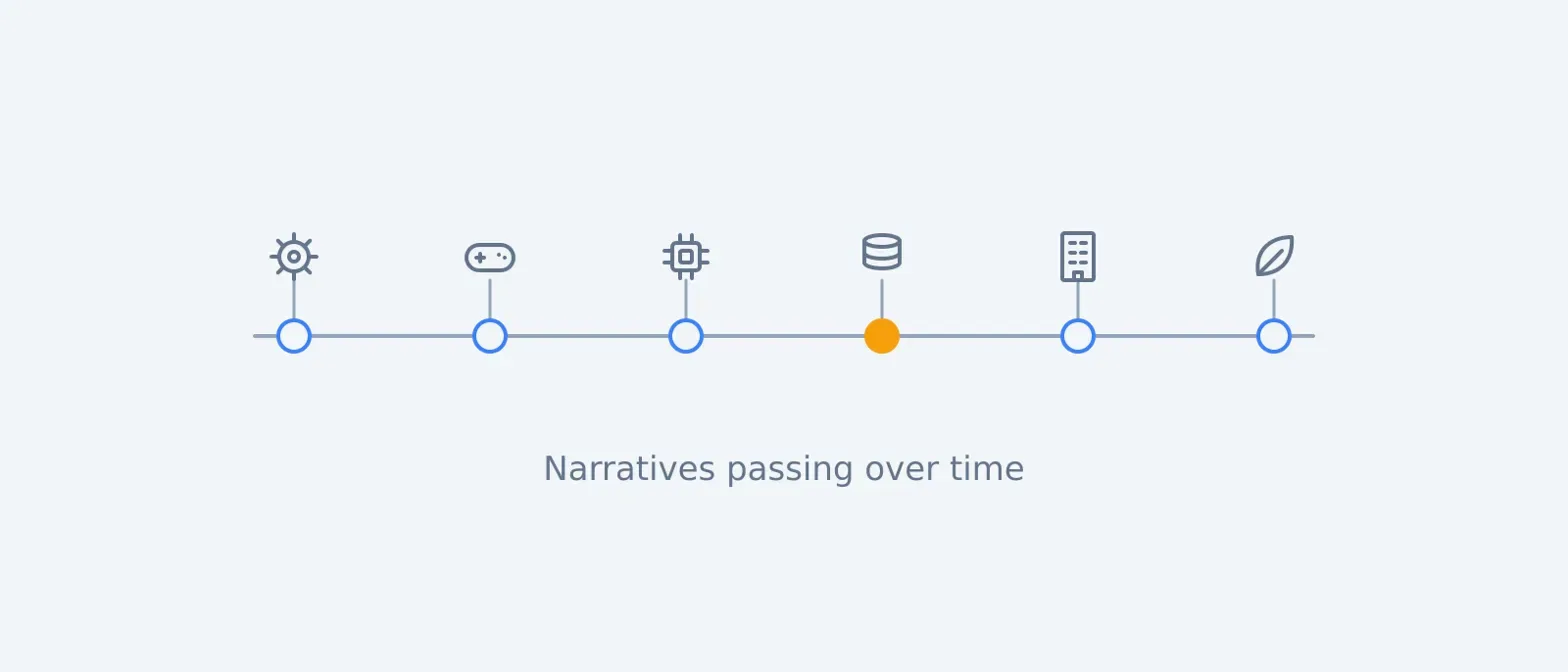
So, what is a crypto narrative? It is a simple idea about the future that a lot of people repeat. It usually has three parts: a story ("savings will move to tokenised funds"), a group of coins that fit the story, and an event that makes people pay attention.
Narratives often follow crypto sectors, which are groups of projects doing similar work, such as lending, gaming or data storage. The difference is time. A sector exists all the time; a narrative is a period when the market pays that sector unusual attention.
A narrative describes attention, not quality. A useful project can sit outside every popular story, and a coin with no working product can rise with one. Whether the product works is a separate question.
How past narratives started, spread and ended
Bitcoin: from electronic cash to a treasury asset
Bitcoin's own story has changed several times. The original paper was titled "Bitcoin: A Peer-to-Peer Electronic Cash System", and the network started in January 2009. The early idea was digital cash for paying online without a bank.
Over time, the story shifted to "digital gold", a store of value. Bitcoin's supply is capped at 21 million, and the reward for creating new blocks halves every 210,000 blocks, roughly every four years. Halvings happened in 2012, 2016, 2020 and 2024, and many people link them with the wider crypto cycle.
Later chapters brought new kinds of buyers. In August 2020, MicroStrategy (renamed Strategy in 2025) began holding bitcoin as a treasury reserve asset. On 10 January 2024, the US Securities and Exchange Commission approved spot bitcoin exchange-traded products, which made bitcoin reachable through an ordinary brokerage account. Bitcoin's narratives rarely ended outright; each new one was added on top of the last.
Ethereum: smart contracts, ICOs and DeFi
Ethereum went live on 30 July 2015, with smart contracts: programs that run on a blockchain exactly as written. The "world computer" idea was that anyone could build applications on one shared network.
That made the 2017 ICO boom possible. In an initial coin offering (ICO), a project sold its own token directly to the public, often with little more than a plan. The boom ended with the 2018 bear market and with regulators: in July 2017 the SEC said some ICO tokens could be securities, and in September 2017 China banned ICOs. Many ICO projects failed, and many of their tokens lost most or all of their value.
"DeFi summer" followed in 2020. DeFi (decentralised finance) means lending, trading and similar services run by smart contracts. In June 2020, Compound began giving its COMP token to people who lent and borrowed on it, and other apps copied the idea. UNI, AAVE, YFI, SNX, CRV and SUSHI became the coins most linked with the theme.
Ethereum moved to proof of stake in the Merge on 15 September 2022, and withdrawals of staked ETH were switched on with the Shanghai upgrade on 12 April 2023. That lifted liquid staking, where a token stands for staked ETH and can still be used elsewhere; Lido's LDO was the most widely known example. In 2025 the story became Ethereum as the chain for stablecoins and company treasuries: the US GENIUS Act, a stablecoin law, passed the Senate on 17 June and was signed on 18 July, while some listed companies added ETH to their balance sheets. ENA, ETHFI, LDO, AAVE and UNI were the coins most often named.
From the 2021 boom to more recent themes
| Narrative | Trigger people remember | Coins most linked | How it ended |
|---|---|---|---|
| Layer 1 race, 2021 | Rival blockchains to Ethereum | SOL, AVAX, LUNA, FTM, NEAR, ATOM | Terra's UST lost its peg in May 2022 and LUNA collapsed |
| NFTs, metaverse and gaming, 2021 | Axie Infinity's growth; Facebook renamed Meta in October 2021 | AXS, SAND, MANA, GALA | Axie's player count fell sharply; its Ronin bridge was hacked in March 2022 |
| AI, first wave | ChatGPT's launch, November 2022 | FET, RENDER, TAO | Lost ground to BTC after the peak |
| AI, second wave | OpenAI's Sora preview, February 2024; later, AI agents | FET, RENDER, TAO | Lost ground to BTC after the peak |
| Solana revival and memecoins, 2023 to 2024 | Airdrops on Solana, including Jito's | SOL and Solana memecoins | Lost ground to BTC after the peak |
| Real-world assets (RWA) | BlackRock's tokenised fund BUIDL, March 2024 | ONDO, OM | OM lost most of its value within a day in April 2025 |
Other themes in the same years included the Bitcoin ecosystem, after ordinals let people inscribe content onto individual satoshis (the smallest unit of bitcoin); restaking, where staked ETH also secures other services, often with "points" that later turned into tokens; on-chain perpetual futures, contracts with no expiry date traded on a blockchain, led by Hyperliquid and its HYPE token; and privacy coins such as ZEC in late 2025. A memecoin is a coin whose main appeal is a joke or a community rather than a product.
What Stratalla's data shows about narrative timing
Stratalla studied 13 narratives from 2020 to 2025 using daily price data from Binance. Each narrative was treated as an equal-weight basket of its coins and measured against BTC, so a gain means the basket did better than bitcoin, not that it made money in dollars.
With made-up numbers: if a benchmark coin rises 10% and a basket rises 21%, the basket is up 10% against the benchmark. If both fall 20%, the basket is flat against it, even though both lost money.
The main findings:
- The move started before the famous trigger. In 11 of the 13 narratives, the basket was already beating BTC one to four months before the event most people remember.
- Several famous triggers came near the top. Facebook's rename to Meta came about 27 days before the metaverse basket peaked. Sora came about 23 days before the second AI wave peaked, BUIDL about 13 days before the RWA basket peaked, and the Jito airdrop about 18 days before the Solana basket peaked.
- The run after the trigger was short. The median time from the remembered trigger to the basket's peak was 67 days, with a median gain of about 182% against BTC over that span.
- The fall after the peak was large. In the 180 days after the peak, the median basket lost about 58% against BTC, and every one of the 13 lost at least 19%.
- Price alone didn't separate real starts from false ones. A price-only rule (70% of a basket's coins beating BTC over 30 days, with the median coin ahead by 20% or more) was met 122 times across the baskets' histories. Ninety days later, the median basket was 13% behind BTC, and only 35% of those cases were ahead.
The study has limits. It only includes coins listed on Binance, the trigger dates are a judgement about what "most people remember", and patterns from the past don't predict future ones.
How the study was done
Each basket holds the narrative's coins that traded on Binance at the time, weighted equally, and its daily result is measured against BTC. A coin joins its basket after 60 days of trading. The peak is the basket's best point against BTC within a year of the trigger.
| Narrative | Remembered trigger | Coins in the basket |
|---|---|---|
| DeFi summer | Compound's COMP rewards, June 2020 | COMP, SNX, LINK, YFI, CRV, SUSHI, UNI, AAVE |
| Layer 1s | Avalanche Rush incentives, August 2021 | SOL, AVAX, FTM, NEAR, ATOM, ALGO, MATIC |
| Gaming (Axie) | Axie Infinity's growth, July 2021 | AXS, SAND, MANA, ENJ, GALA, CHR, ALICE |
| Metaverse | Facebook renamed to Meta, 28 October 2021 | the same gaming and metaverse coins |
| Liquid staking | Shanghai upgrade scheduled, December 2022 | LDO, SSV, FXS, RPL |
| AI, first wave | ChatGPT, 30 November 2022 | FET, AGIX, OCEAN, RENDER |
| AI, second wave | Sora, 15 February 2024 | FET, AGIX, OCEAN, RENDER, WLD, ARKM |
| Bitcoin ecosystem | Binance listed ORDI, November 2023 | ORDI, STX |
| Solana revival | Jito airdrop, December 2023 | SOL, RAY, JTO, JUP, PYTH, BONK |
| Memecoins | Bitcoin near its high, February 2024 | PEPE, FLOKI, BONK, WIF, SHIB, DOGE |
| Real-world assets | BlackRock's BUIDL fund, March 2024 | ONDO, OM, POLYX, PENDLE, LINK, MKR |
| ETH treasuries | Companies buying ETH, June 2025 | ETH, ENA, ETHFI, LDO, AAVE, UNI |
| Privacy | Interest in Zcash, October 2025 | ZEC, DASH |
What changed before the price did
In the cases that became real narratives, the first clear change was usually outside price, and it could be checked:
- Usage and deposits. DeFi apps saw growing use and deposits in 2020.
- Users and revenue. Axie Infinity's players and revenue grew in May and June 2021.
- A technology shift outside crypto. ChatGPT reached about 100 million users in about two months.
- A fixed date that changed token economics. The Shanghai upgrade had a known date that let staked ETH be withdrawn.
- Growth in a new product. Tokenised US Treasury funds grew during 2023, before BUIDL's launch.
- A law moving forward. The stablecoin bill passed the US Senate in June 2025.
Each of these is something a reader can look up: usage figures, revenue, a calendar date, a bill's progress. None of them is a chart pattern.
How to tell a real narrative from hype
Questions to ask
- Is there a dated trigger? A launch, an upgrade, a law or a product, not just "people are talking about it".
- Is there a measurable change outside price? Users, deposits, fees or revenue that someone can count.
- Is there a new kind of buyer? Companies, funds or users who weren't in crypto before.
- Are the coins liquid? Coins with little trading can swing sharply on small amounts of money, in both directions.
- Would the project make sense without the label?
The stages a narrative goes through
- Quiet change. Something real shifts, and few people notice.
- Recognition. A dated event gives the story a name, and the most traded coins in the group move first.
- Spread. Smaller coins join, and new buyers arrive.
- Crowding. Everyone knows the story, and the label is everywhere.
- Unwind. Attention moves elsewhere, and most coins in the group lose ground.
Warning signs of the late stage
- A flood of new tokens using the label
- Older projects rebranding into the theme
- Mainstream coverage, the way the metaverse reached front pages after the Meta rename
- Good news that no longer lifts prices
These signs describe the mood of a market, not a timetable. Stratalla doesn't tell readers what to buy or sell, and it doesn't predict prices; the study above describes what happened in the past. For the basics of risk and planning, the crypto academy has lessons with quizzes.
This article is for education only. It isn't financial advice, and nothing here recommends buying or selling any asset. Crypto prices can fall sharply, and you can lose money. Consider your own situation, and speak to a qualified adviser if you need personal guidance. This article was prepared with the help of AI and reviewed by a person, but AI can make mistakes, so check important facts.
Related articles
-
 Market structure
Crypto Cycle Explained: The Four Phases of the Market
What a crypto cycle is, the four phases people describe, the moods that come with each, and why cycles are only clear in hindsight and can't be reliably timed.
-
 Market structure
Crypto Trading Volume Explained: Compare It to Its Average
What trading volume measures, why big and small coins can't be compared on raw volume, and why a coin's own recent average is a more useful yardstick.
-
 Market structure
Swing High, Swing Low in Crypto: What They Mean
Prices move in swings, not straight lines. Learn what swing highs and lows are, how they show a market's shape, and why the timeframe changes which swings matter.