Data Center Moratorium: What It Means for AI Coins
What a data center moratorium is, who can impose one, how elections bring them about, and how a pause on new data centers can reach AI coins, without predictions.
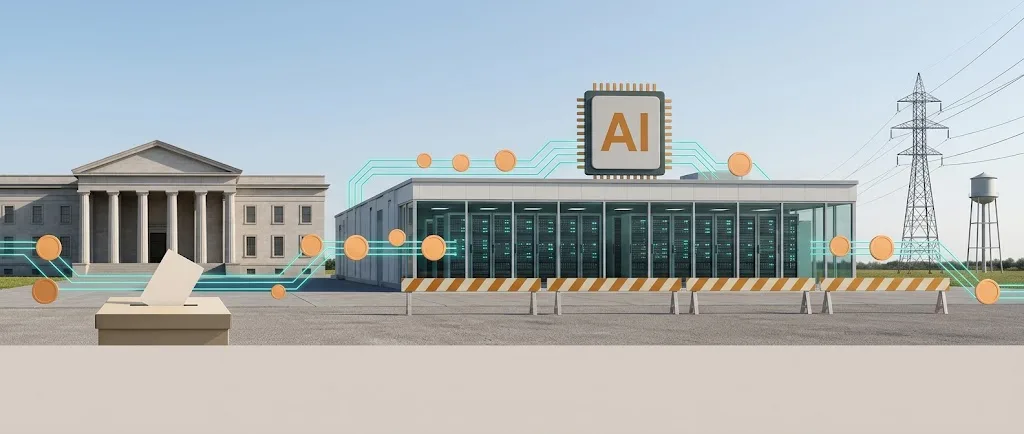
A data center moratorium is a pause on approving or building new data centers, usually while officials write permanent rules. Pauses like this have become a common campaign promise, and an election can bring one in, extend it or end it. Because AI runs in data centers, a pause can reach the wider AI sector and the crypto coins linked to it. This guide explains what a moratorium is, who can impose one, how it can reach AI coins, and which questions help separate a lasting change from a headline.
What is a data center moratorium?
A moratorium is a temporary stop. For data centers it usually means no new permits, building approvals or grid connections for sites above a certain size, for a set period. That period is often somewhere between six and eighteen months, while officials study the effects and write permanent rules. It can be extended, made permanent, or lifted early.
Different levels of government can impose one:
- Cities and counties, through zoning and building permits. This is where most pauses start.
- States, through a law, a utility regulator's decision or an order from the governor. The National Conference of State Legislatures keeps a list of states considering data center bans.
- The national government, through a law passed by Congress. A national pause is much harder to pass than a local one.
The reasons given are usually local: rising power bills for households, strain on the electricity grid, water used for cooling, land use, noise, and tax breaks granted to large builders.
Three real cases
Details in this section are as of 6 November 2026 and may change.
- A city pause that passed. On 6 October 2026, the city council of Raleigh, North Carolina, approved a six-month pause on development approvals, including water and sewer connections, for larger data centers: any that has on-site staff, a footprint over 10,000 square feet, or a peak power demand over 5 megawatts. Projects that had already filed a complete application can still be judged under the earlier rules once processing resumes. The pause ends by 6 April 2027 at the latest, or sooner if the council adopts permanent rules first.
- A statewide pause by executive order. On 14 July 2026, New York's governor, Kathy Hochul, ordered the first statewide pause: for up to one year, state environmental permits for new data centers of 50 megawatts or more are on hold while the state writes standards for them. It does not apply to smaller projects, to projects whose applications the state had already accepted as complete, or to projects that need no such permit. A stricter bill with a 20-megawatt threshold passed the state legislature in June, but it had not been signed in the reports available when this was written.
- A state pause that was stopped. Maine's legislature passed a bill that would have paused new data center projects needing 20 megawatts or more until November 2027. In April 2026, Governor Janet Mills vetoed it, objecting that it had no exemption for one planned project, and said she would set up a council to study data centers by executive order instead. The legislature did not override the veto.
Two of these pauses took effect, one through a city council vote and one through a governor's order; the third stopped one step before becoming law.
Why elections matter
Pauses like this are popular with many voters, so candidates campaign on them, and some appear directly on the ballot. An election changes who can impose, extend or lift one. A new mayor, county board or governor can move faster than a national legislature, which is why many pauses start locally.
What links data centers to AI coins?
AI coins are crypto tokens linked to projects that sell or coordinate computing power, data, AI models or software "agents" that act on a user's behalf. In some, the coin pays for a real service, such as renting graphics processors (GPUs, the chips most AI runs on). In others it is mainly used for voting on the project's rules. Some carry the AI label with little behind it. The guide to AI crypto tokens explains the main types and how to tell them apart.
These coins sit next to a much larger AI sector of chip makers, cloud providers and data center builders. When news suggests fewer data centers will be built, expectations for that whole sector change, and AI coins often move with it, even when a project has nothing to do with data centers. Many AI coins are also small, so a modest wave of buying or selling can move them a long way.
Two channels: crypto rules and AI infrastructure rules
A pause on data centers is only one of two ways politics reaches AI coins.
The first channel is crypto rules: whether a token counts as a security, how exchanges may list it, how it is taxed, and how strictly rules are enforced. In the United States, Congress writes federal laws, and agencies such as the SEC and the CFTC apply them. When a new crypto regulation bill is in the news, that is this channel.
The second channel is AI infrastructure rules: power, land, water and chips. The International Energy Agency's report on energy and AI describes how much electricity data centers use and why AI is adding to that demand. Pauses on new building belong here, along with power prices, grid connections and national limits on exporting advanced chips.
| Channel | Who decides (US) | What can change | How it can reach an AI coin |
|---|---|---|---|
| Crypto rules | Congress, SEC, CFTC | Token status, listings, tax, enforcement | Who can trade it, and how easily |
| Power and land | Cities, counties, states, utility regulators | Pauses on building, power prices, permits | Cost and supply of computing |
| Chips | National government | Export limits on advanced chips | Which hardware a network can use, and where |
The same election can tighten one channel and loosen another, so crypto politics at the national level can point a different way from building rules in a single state.
From campaign to rule: what changes at each stage
An election result changes who decides. It doesn't pause anything by itself. Between a campaign promise and a pause that affects real projects there are several stages, and each can take time, change shape, or stop.
| Stage | What changes | What hasn't changed yet |
|---|---|---|
| Campaign | Promises and expectations | Any rule |
| Result or ballot vote | Who decides, or a local measure passes | Most rules, until they take effect |
| New rule | The written text: size limits, length, exceptions | How it is applied |
| Pause in force | No new approvals in that area | Data centers already built or approved, usually |
| Review | Extended, made permanent or lifted | — |
The details that decide the real effect come at the later stages: which sites count, how long the pause lasts, and whether existing projects are exempt. A national pause would also need a majority in both chambers of Congress and the President's signature, or a two-thirds vote in both chambers to override a veto. That is a much higher bar than one city council vote, which is one reason many pauses start locally.
A worked example with made-up numbers
Here is an invented case. "Token Z" runs a decentralized network where people rent out their GPUs for AI work and are paid in Token Z. All numbers are made up.
A provider in an imaginary region earns the equivalent of $0.80 for each hour a GPU is rented. Their costs per hour are $0.20 for electricity and $0.40 for everything else (hardware, internet, upkeep). They keep $0.20 an hour.
A newly elected regional government pauses new large data centers and, to ease household bills, raises electricity prices for heavy users by 50%. Electricity goes from $0.20 to $0.30 an hour, so the provider now keeps $0.10, half as much. Some providers may leave the network.
But companies that wanted new data center capacity now look for spare computing elsewhere, and some of that demand may reach networks like Token Z. If rental demand rises, the hourly pay can rise too.
One decision, two effects pulling in opposite directions. The headline might say "data center crackdown," and the coin might jump or drop that day. What it means for this project depends on details the headline doesn't carry.
Reading moratorium news without predicting
These questions help separate a lasting change from a passing headline:
- Which stage is it at? A promise, a vote, a rule in force, or a review?
- Which level decided? A city, a state or the national government, and how much computing sits in that area?
- What does it cover? All new sites, or only those above a certain size? Are approved projects exempt?
- How long does it last, and what happens at the end?
- What does the coin do? Payment for computing, a voting tool, or mainly a label?
- Is the move about this project or the whole AI group? If every AI coin moves together, the market is reacting to a theme.
- How much of a portfolio sits in one theme? Several AI coins can behave like a single position.
A pause announced while crypto prices are rising and the same pause announced while they are falling is the same rule; only the mood around it differs. The guide to the crypto cycle explains how those moods change, which helps keep the rule and the market's reaction apart.
About Stratalla's tools. Stratalla's crypto screener shows coins sorted by swing measures, volume category, market cap tier, and distance from the all-time high. Swing measures describe how far a coin has moved from its last structural low or high, compared with its own history, which shows whether a move after the news is unusual for that coin. The portfolio tool works out each holding's allocation, so it is easy to see how much depends on one theme.
Stratalla doesn't tell readers what to buy or sell, and it doesn't predict prices. For the groundwork on risk and planning, the crypto academy has lessons with quizzes.
This article is for education only. It isn't financial advice, and nothing here recommends buying or selling any asset. Crypto prices can fall sharply, and you can lose money. Consider your own situation, and speak to a qualified adviser if you need personal guidance. This article was prepared with the help of AI and reviewed by a person, but AI can make mistakes, so check important facts.