What Are AI Crypto Tokens? A Plain-English Guide
What AI crypto tokens are, how they differ from the 'tokens' AI chatbots count, the main types, how a decentralized compute network works, and questions to ask.
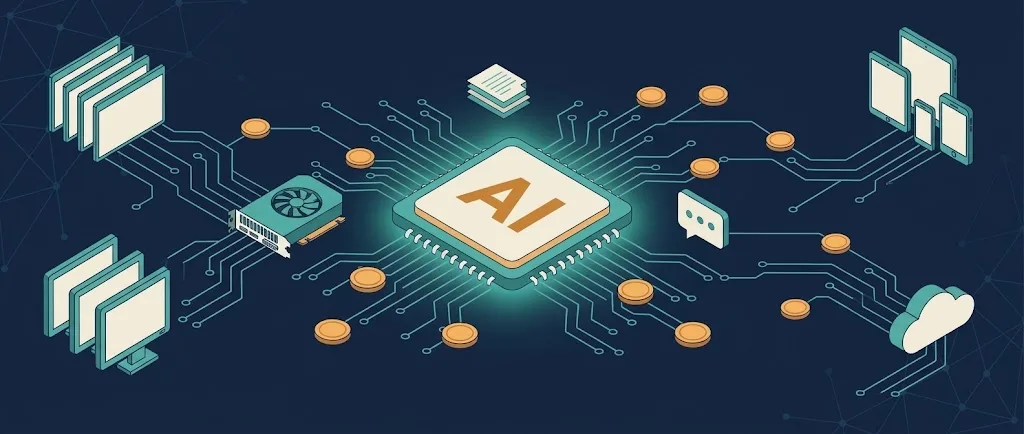
AI crypto tokens are cryptocurrencies linked to projects that sell, share or coordinate something artificial intelligence needs: computing power, data, models or software that acts on its own. The name causes confusion, because "tokens" also means the small pieces of text that AI chatbots read and write, and those have nothing to do with crypto. This guide explains what these tokens are, the main types, how one common kind of network works, and the questions that show whether a token has a real job.
What are AI crypto tokens?
A crypto token is a digital asset recorded on a blockchain, a shared ledger that many computers keep in sync. The AI kind is issued by a project that works in or around AI. The token might pay for a service, reward people who contribute, or give holders a vote on the project's rules.
The other meaning of "token" comes from AI models themselves. A chatbot breaks text into small pieces, often parts of words, and those pieces are called tokens. AI companies count them to measure and bill usage. They can't be bought, sold or held, and they are not cryptocurrency. Many searches for "AI tokens" are about this second meaning, so it helps to check which one a page is talking about.
What types of AI coins are there?
AI coins are a loose group. Price and data sites assign their own category labels, and a project can fall into more than one type.
| Type | What the network does | What the token is used for |
|---|---|---|
| Decentralized compute | Matches people who need GPU time with people who have spare GPUs | Payment to providers, sometimes a deposit |
| Data networks | Collects, labels or shares data used to train AI | Rewards for contributors, payment for access |
| Model and agent networks | Rewards useful AI output, or lets software agents act and pay | Rewards, fees, voting |
| AI-labeled tokens | Uses AI in its marketing, with little or no AI service | Often only trading or voting |
GPUs (graphics processing units) are the chips most AI models are trained and run on. They are expensive and often in short supply, which is why several projects try to pool spare ones.
How a decentralized compute network works
Decentralized compute is the easiest type to picture. Instead of renting from one large cloud company, a customer rents computing time from many independent providers, and the network handles matching and payment. A typical flow looks like this:
- A provider joins. They list their GPU and may lock up some tokens as a deposit that can be cut if they cheat.
- A customer asks for work. They describe the job and pay, in the token or in another currency that the network converts.
- The network assigns the job to one or more providers.
- The network checks the work. This is the hardest part. Networks repeat small parts of a job, run spot checks, or rely on providers' track records.
- The provider is paid, and the network usually keeps a fee.
A worked example with made-up numbers
"Network Q" charges 2 Q-tokens per GPU-hour. A customer needs 10 GPU-hours and pays 20 Q-tokens. The provider receives 18 and the network keeps 2 as a fee. With a made-up token price of $0.50, the customer pays $10 and the provider earns $9.
Now the token's price halves to $0.25 while the network still charges 2 tokens an hour. The customer pays only $5, and the provider earns $4.50, but their electricity bill hasn't changed. Some providers may stop offering their GPUs. If the network instead sets prices in dollars and converts, the customer needs 40 tokens for the same job.
The lesson: the token's price and the usefulness of the service affect each other. A falling price can weaken the service, and a weak service gives fewer reasons to use the token.
Does the token have a real job?
These questions help separate a token with a working purpose from one that mostly carries a label:
- Is the token needed to use the service, or could the service run just as well on dollars or a stablecoin?
- Who uses the service today? Paying customers, or mostly people earning rewards?
- Where do rewards come from? Fees paid by users, or new tokens created from nothing? New tokens dilute existing holders.
- How much supply is still to be released, and on what schedule? Large future releases (unlocks) add selling pressure.
- Who controls the project? A small team, a foundation, a few large holders, or a wide group?
- Can the network show the work was really done?
- Would the project make sense without the word "AI"?
What risks are specific to AI coins?
Headlines move them as a group. AI coins often rise and fall with news about the wider AI sector, even when that news has nothing to do with a given project.
They compete with very large companies. A decentralized network has to match big cloud providers on price, reliability and ease of use. That is a hard bar to clear.
Many are small. A small market value and thin trading mean prices can swing sharply on modest buying or selling.
They face two sets of rules. Crypto rules apply to the token, and rules on chips, power and data centers apply to the AI work behind it. A data center moratorium is one example of the second kind.
The label can outrun the product. When a theme is popular, more projects adopt the name. The questions above are a way to check what is underneath.
Where AI tokens sit in the wider market
Most AI coins are smaller than the largest cryptocurrencies, which places them in the lower crypto market cap categories. Coins in those tiers tend to move more sharply than the largest ones.
Stratalla's crypto screener shows coins sorted by swing measures, volume category, market cap tier, and distance from the all-time high. Swing measures describe how far a coin has moved from its last structural low or high, compared with its own history, which helps put a sharp move in context. The portfolio tool works out each holding's allocation, so it is easy to see how much of a portfolio sits in one theme.
Stratalla doesn't tell readers what to buy or sell, and it doesn't predict prices. For the basics of risk and planning, the crypto academy has lessons with quizzes.
This article is for education only. It isn't financial advice, and nothing here recommends buying or selling any asset. Crypto prices can fall sharply, and you can lose money. Consider your own situation, and speak to a qualified adviser if you need personal guidance. This article was prepared with the help of AI and reviewed by a person, but AI can make mistakes, so check important facts.