How to Track Your Crypto Portfolio Without Connecting an Exchange
Track your crypto portfolio manually, with no API keys or exchange access: what to record, three simple methods, and how to review it without stress.
Quick test. Can you answer these three questions without opening your exchange?
- What was your average buy price for each coin?
- How much have you paid in fees this year?
- Why did you buy the last coin you bought?
If you hesitated, you're in good company. Most investors know roughly what they hold, but not what they paid or why. Those are exactly the details you need when markets get rough, and the first ones to get lost.
The good news: you don't need to give any app access to your exchange to fix this. Here's a simple crypto portfolio tracking system that takes about 30 seconds per trade.
Why not just connect your exchange?
Many crypto portfolio trackers ask for API keys or a wallet connection. It's convenient, but it comes with trade-offs:
- Your keys live on someone else's server. When such services have been breached, leaked API keys have been used to place unwanted trades on people's accounts.
- Syncing isn't always right. Transfers between exchanges and wallets often show up as wrong buys, sells or missing coins.
- You stop paying attention. When everything imports itself, you never stop to ask why you made a trade.
Tracking by hand fixes all three. Those 30 seconds of typing are when you actually think about your decision.
What to record for every trade
Six fields are all you need:
- Date
- Coin
- Amount bought or sold
- Price per coin
- Fees, including transfer costs
- Reason, in one sentence: "monthly DCA buy" or "rebalancing back to my target"
The reason is the field most people skip, and it's the most valuable. Months later it shows you whether you followed your plan or chased the news.
Three ways to keep the record
| Method | Best for | Downside |
|---|---|---|
| Notebook | A few trades a year | No totals, no charts |
| Spreadsheet | People who like building their own formulas | Easy to break, all the math is on you |
| Stratalla portfolio | Regular investors and DCA plans | You still enter each trade yourself |
In the Stratalla portfolio you enter trades yourself, and it works out your average buy price, fees and allocation for you. It also keeps your entry and exit plans next to your holdings. It never connects to your exchange or wallet, never asks for API keys and never trades for you.
Whichever you choose, one rule matters: record each trade on the day it happens, not from memory at the end of the month.
Review on a schedule, not on a feeling
Checking prices ten times a day causes stress and leads to impulsive decisions. Instead, pick a review rhythm, monthly or quarterly, and put it in your calendar. Then ask four questions:
- Has my allocation drifted? If one coin has grown far bigger than planned, decide calmly whether to rebalance.
- Am I sticking to my schedule? If you've skipped planned buys, find out why before you change the plan.
- Has my life changed? A new job, a big expense or a need for cash can mean the plan should change too.
- Do my reasons still hold? Re-read the reason column. If a reason no longer applies, write that down and decide what to do.
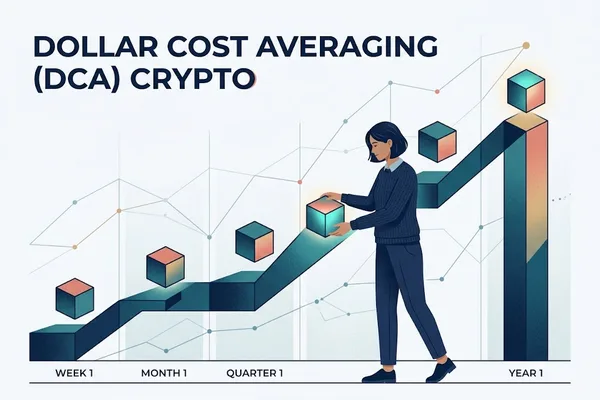
If you invest on a schedule, this pairs naturally with dollar cost averaging.
What tracking can't do
A record shows what happened. It can't predict prices or tell you what to buy or sell, and it only works if you log every trade. One missing transaction and your numbers are off.
Start in five minutes
Write down what you hold today, add the trades you remember with their prices and fees, and set a review reminder. Tracking is a habit, not a tool: the value comes from writing it down and checking it on a schedule.